

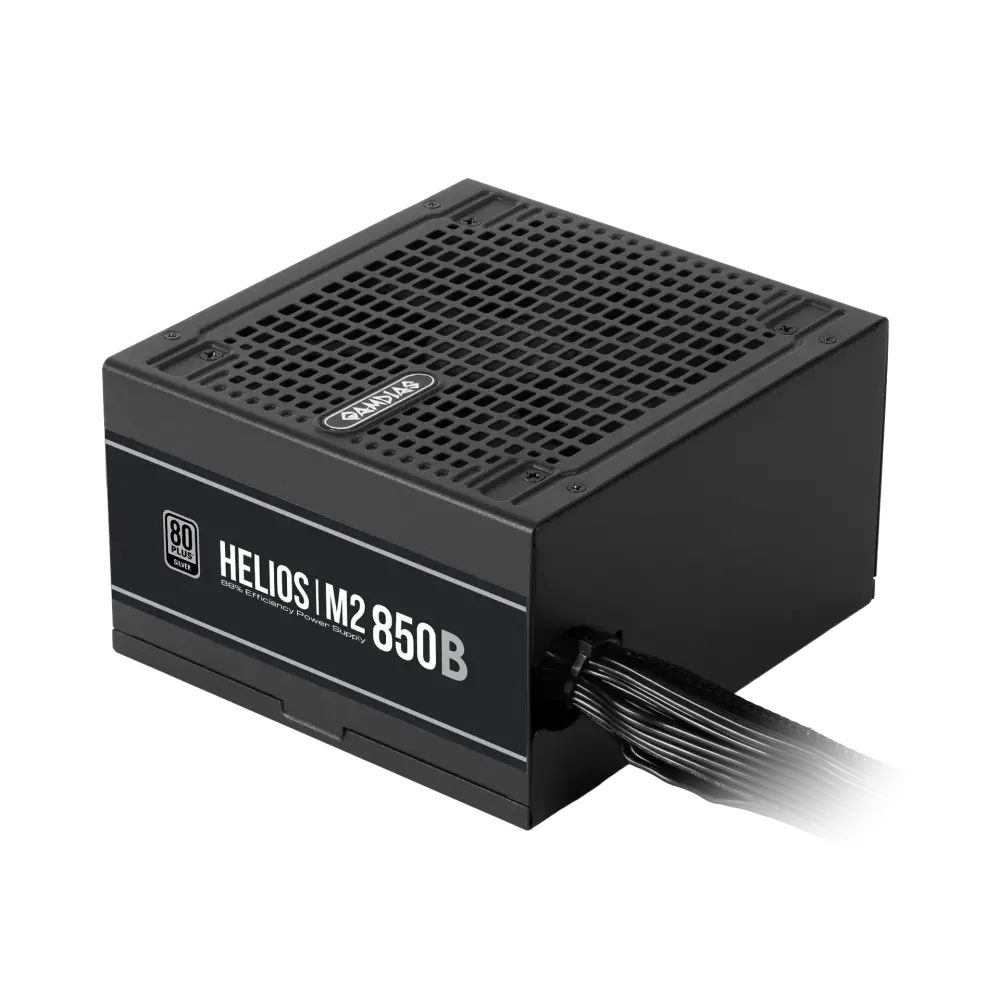
The GAMDIAS HELIOS M2-850B is an 850W ATX 3.1 power supply with 80 PLUS Silver certification and a native 12V-2x6 cable. It's a solid match for RTX 5070 and RTX 5070 Ti builds that want comfortable headroom without power adapters.
Key features
- 850W continuous output
- 80 PLUS Silver, measured at 89.01% efficiency at 50% load
- ATX 3.1 with PCIe 5.1, handles GPU power spikes up to 200%
- Native 12V-2x6 (12VHPWR) cable for RTX 50 series cards, no adapters
- Single +12V rail with DC-to-DC circuitry
- 120mm smart fan that adjusts its speed to temperature
Specifications
| Output | 850W continuous |
|---|---|
| Efficiency | 80 PLUS Silver (88.48% at 20% load, 89.01% at 50% load) |
| Certification record | CLEAResult 7551 |
| Standard | ATX 3.1, PCIe 5.1 |
| Power excursion | Up to 200% |
| GPU cable | Native 12V-2x6 (12VHPWR) |
| Rail design | Single +12V rail, DC-to-DC |
| Fan | 120mm smart fan |
| Power factor | Active PFC |
| Model | HELIOS M2-850B |
Good to know
Higher efficiency means less heat inside the unit and a quieter fan during long gaming sessions. If an RTX 5080 or RTX 5090 is on your upgrade plan, a 1000W unit such as the HELIOS P2-1000G is the better starting point. Covered by a two-year warranty against manufacturing defects.
FAQ
Is 850W enough for an RTX 5070 Ti?
Yes. The RTX 5070 Ti draws about 300W, and with a Ryzen 7 class CPU the whole system stays under 600W, leaving more than 250W for power spikes and light upgrades.
Do I need an adapter for RTX 50 series cards?
No. The native 12V-2x6 cable plugs straight into cards like the RTX 5070 and RTX 5070 Ti, with fewer failure points and tidier cabling.
Can I upgrade to an RTX 5080 later?
An RTX 5080 (360W) can run on 850W, but the margin gets tight with high-end CPUs. If that upgrade is planned within a year or two, start with a 1000W unit.